
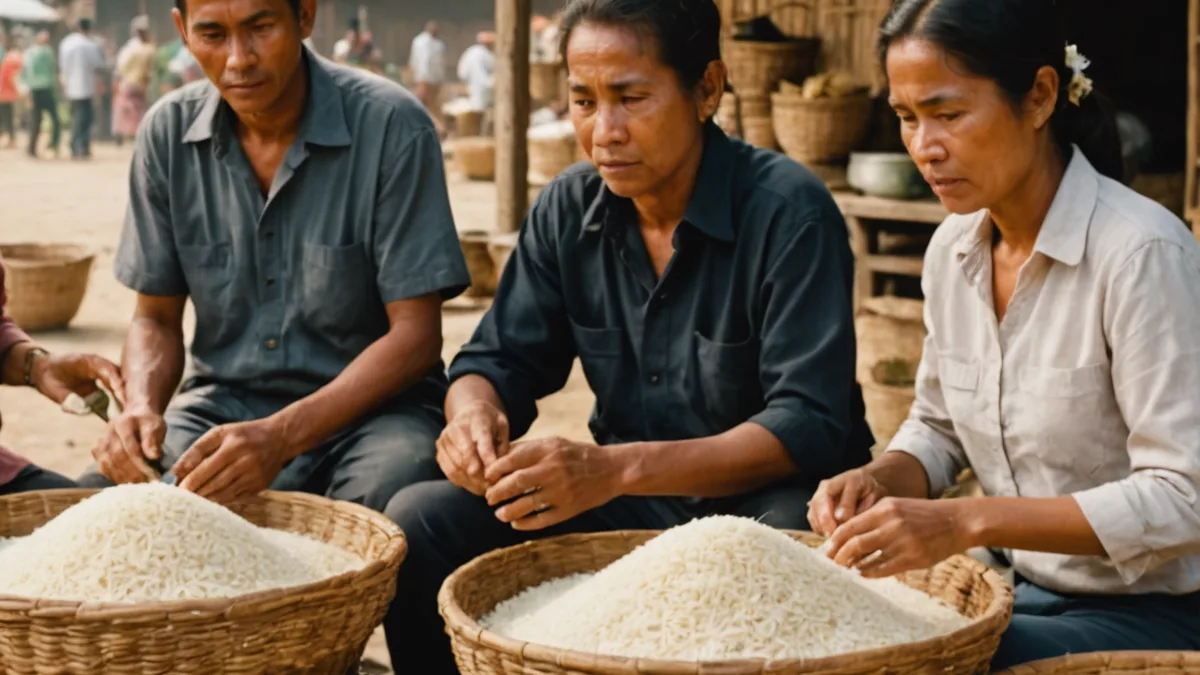
The informal channel is not a failure. It is the incumbent.
When we started working on market linkage for Elevarm, we assumed the problem was that farmers had no access to buyers. That is not quite right. Most smallholder rice farmers in West Java have established buyer relationships: a local collector (pengepul) who comes to the field at harvest, a cooperative buyer, or a rice mill with a standing relationship going back ten or fifteen years. The market connection exists. The problem is that the terms of that connection are almost entirely determined by the buyer at the moment of transaction.
The collector arrives at harvest and names a price. The farmer can accept or try to find another buyer, but finding another buyer during the active harvest window means the grain continues to shed and moisture increases, both of which cost the farmer in either weight or grade. The practical negotiating power is with the buyer, not the farmer, and the structural reason is simple: the farmer has one moment to sell, the buyer has many moments to buy across many farmers.
What we learned from working on this is that the intervention has to happen before harvest, not during it. Once the combine is in the field, the negotiating position of the farmer is at its weakest. A pre-harvest buyer connection, made while the crop still has three to four weeks before maturity, is a qualitatively different conversation.
What a pre-harvest connection actually requires
For a buyer to commit to a price before harvest, they need two things. First, a reliable estimate of what the farmer will deliver: volume, grade, and timing. Second, a reason to trust that estimate, meaning some accountability mechanism if the actual delivery falls significantly short of the commitment.
Elevarm's harvest timing model gives us the first element. When a Petani Pro farmer is three to four weeks from their predicted maturity window, the platform generates an expected harvest estimate based on plot size, observed NDVI-based greenness signals, and the variety's expected maturity yield for the soil class. This is an estimate with uncertainty, not a guarantee, but it is close enough that vetted buyers are willing to negotiate on it.
The accountability mechanism is the farmer's ongoing relationship with the platform. A farmer who systematically over-reports yield estimates loses access to pre-harvest introductions. This is not a punitive system; it is just how market trust works. Buyers in the Elevarm network know that connected farmers have an incentive to report accurately because their future access depends on it.
Transparent pricing is harder than it sounds
The part we underestimated was the pricing transparency side. We started with the assumption that publishing a reference price would be useful to farmers, and that buyers would participate because they could source more reliably by committing early. Both assumptions were partially correct and partially wrong.
Farmers found the reference price useful but confusing. If the reference price for Ciherang at the farm gate in Subang is IDR 5,400 per kilogram, but a farmer's harvest has a moisture content of 28% instead of the standard 14%, the effective price is not IDR 5,400. It is significantly less, after the buyer applies a moisture penalty. Many farmers did not understand the moisture-price relationship well enough to interpret the reference price correctly as applied to their actual harvest. We spent the second quarter of 2025 building an in-app moisture adjustment calculator specifically because of this confusion.
On the buyer side, some of the collectors we initially approached were resistant to the transparency model entirely. Their business model depends in part on information asymmetry at the moment of transaction. Pre-committing to a price removes a tool they have relied on for years. We lost several early conversations with collectors for this reason. The buyers who joined the Elevarm network are a self-selected group who see the reliability and volume predictability benefits as worth the trade-off.
What changed for farmers who used it
Among early-access farmers who connected to buyers through the platform before their 2025 harvest, we observed two consistent differences compared to their prior seasons. First, they reported less post-harvest grain sitting unsold for more than two days. Second, the price they received per kilogram was at or above the reference price for their moisture grade more often than not.
We are careful about attributing this entirely to the pre-harvest connection. Farmers who are active enough to use Elevarm and pursue a buyer introduction are probably also more organized about their harvest logistics in general. Selection effects are real. What we can say is that the pre-harvest connection did not hurt any farmer who used it, and for most it reduced the anxiety and uncertainty of the harvest period in ways that are hard to quantify but clearly valuable to the people involved.
What we are not trying to do
We are not trying to replace the local collector network. The collectors and rice mills who operate in Subang and Karawang have infrastructure, transport relationships, and cash-flow cycles that would take years to replicate. We are trying to add price transparency and pre-commitment options to a market that has historically had neither, without requiring every transaction to flow through Elevarm as an intermediary.
The model we are building is closer to a price information and introduction service than a marketplace in the traditional sense. Farmers and buyers close their own transactions. Elevarm provides the timing signal, the reference price anchor, and the introduction. That scope is narrower than some investors expect, but it is appropriate for where we are and for the trust relationships we need to build before we can claim a larger role in the transaction.
Getting the timing right is the whole game. A farmer who knows their optimal harvest window and has a buyer ready when that window opens is in a materially better position than a farmer who harvests by calendar and then searches for a buyer. Building that timing signal accurately and delivering it reliably is what we are focused on for the next two planting cycles.